
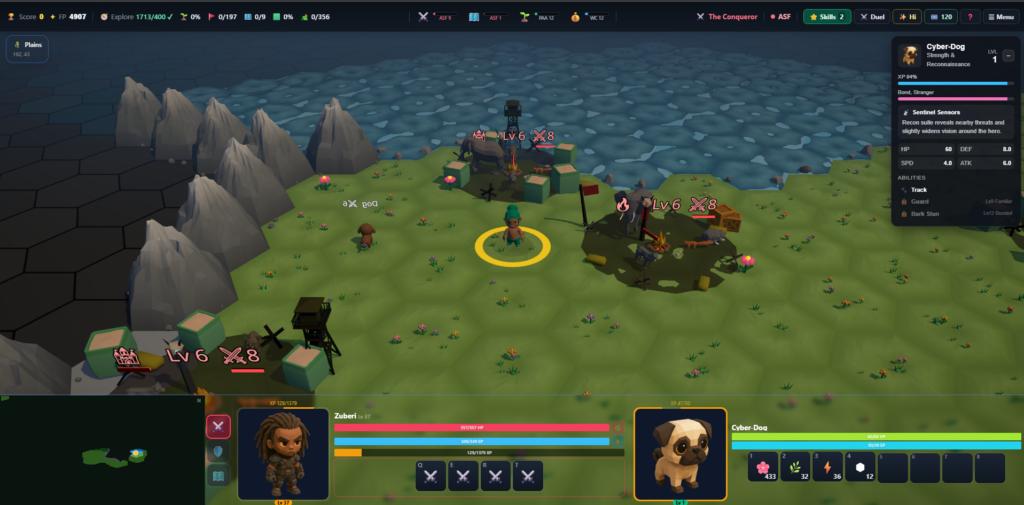
One of the biggest challenges when building a game from scratch is knowing when to stop building systems and start building a world.
For the past few months, Afro-Future Rising has mostly been a collection of mechanics. Movement worked. Exploration worked. Skills, pets, progression, and combat all existed in one form or another. But despite all that, the game still felt… empty.
This development cycle was about changing that.
Instead of adding another gameplay mechanic, I focused on making the world itself feel believable.
Moving Beyond Placeholder Assets
Until now, almost everything in the project was represented by simple geometry.
Cubes became buildings.
Cylinders became trees.
Colored hexagons represented terrain.
It was enough for testing mechanics, but after spending hundreds of hours looking at placeholder objects, I reached the point where I needed to start visualizing the actual game.
To speed things up, I began integrating production-ready assets from the Fab Marketplace.
I’m currently using a combination of FBX and GLTF models depending on what works best for the browser pipeline.
The first batch includes:
- Wildlife and animals
- Enemy characters
- Camps and settlements
- Military outposts
- Base structures
- Environmental props
The goal isn’t to create the final visual style just yet.
It’s about replacing abstract shapes with recognizable objects so I can better judge scale, spacing, readability, and gameplay.
It turns out that simply replacing a cube with an actual camp immediately changes how players understand the world.
Improving the Terrain System
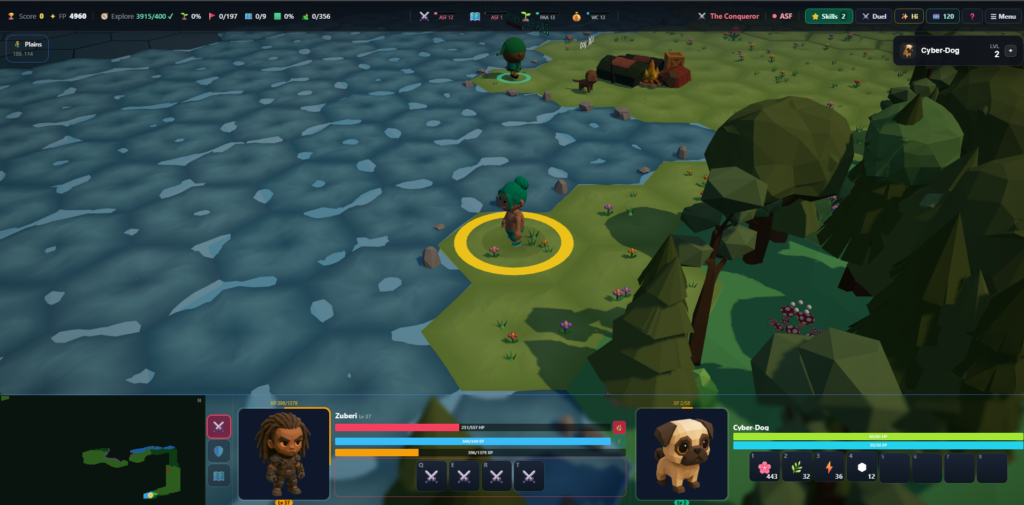
At the same time, I spent quite a bit of time reworking how terrain is generated inside Three.js.
Earlier versions simply assigned colors to hexagonal tiles.
Now each terrain type can generate its own geometry and environmental details.
Different biomes now have their own identity.
For example:
- Forest tiles generate vegetation and trees.
- Mountain regions create elevated terrain and rock formations.
- Water tiles have dedicated geometry instead of simply being blue hexes.
- Hills create smoother elevation transitions and natural barriers.
This is a much more scalable approach because the terrain itself now knows how it should look instead of relying on one giant generation script.
As the project grows, this should make it much easier to introduce new biomes without rewriting large portions of the engine.
Making the World Feel Cohesive
Something interesting happened once these two systems came together.
The terrain generator started placing actual environments.
The assets started populating those environments.
Suddenly the world stopped looking like a prototype.
It started looking like somewhere I’d actually want to explore.
There are still plenty of placeholder assets and lots of visual inconsistencies, but for the first time I found myself walking around simply to see what was over the next hill.
That’s probably the biggest compliment I can give the current build.
The game is slowly becoming enjoyable even when I’m not actively testing a specific feature.
Why I Didn’t Model Everything Myself
I’ve had a few people ask why I’m using marketplace assets instead of building every model from scratch.
The answer is pretty simple.
As a solo developer, time is my most limited resource.
I’d rather spend hundreds of hours designing gameplay systems than reinventing every rock, tree, or tent.
Marketplace assets let me answer much more important questions early:
- Is the level fun?
- Does navigation work?
- Can players recognize important landmarks?
- Is combat readable?
- Does exploration feel rewarding?
Once those questions are answered, replacing assets with custom art becomes much easier.
Gameplay first.
Art polish second.
The Browser Is Becoming a Real Playground
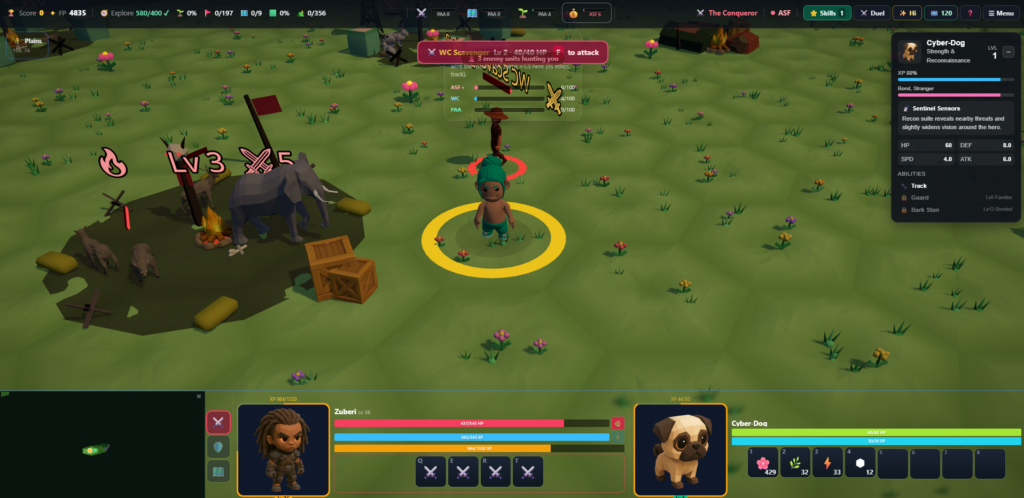
One thing I’m really happy with is sticking to the browser prototype.
Originally it was just supposed to help me test mechanics before moving everything into Unreal Engine.
But it’s becoming much more than that.
Having an instantly playable build means I can make a change, refresh the browser, and immediately test it.
No packaging.
No lengthy compilation.
No waiting.
That feedback loop has probably doubled my productivity compared to doing everything directly inside a game engine.
It’s also making it much easier to think about eventually supporting a lightweight browser version of Afro-Future Rising alongside the PC release.
What’s Next
With the environment finally taking shape, it’s time to shift focus back to gameplay.
The next milestone is implementing the first complete solo mission.
Rather than simply dropping players into the world, I want them to have clear objectives that teach the core gameplay loop naturally.
That means introducing:
- Exploration objectives
- Resource gathering
- Capturing strategic locations
- Enemy encounters
- Mission rewards
- Story progression
The goal is to have a complete mission that represents the core experience from beginning to end.
Even if it’s only fifteen or twenty minutes long, it’ll be the first true vertical slice of the game.
Mobile Optimization
The other major focus will be performance.
Although the primary release target remains PC, I still want the browser prototype to run smoothly on lower-powered devices.
The combination of procedural terrain, GLTF assets, vegetation generation, and dynamic systems is starting to become expensive, especially on mobile hardware.
Over the next few weeks I’ll be profiling the renderer and optimizing things like:
- Geometry instancing
- Asset loading
- Draw calls
- Texture compression
- Terrain chunk streaming
- Memory usage
The smoother the browser build becomes, the easier it will be to iterate on gameplay.
Looking Back
This update probably won’t look as exciting as adding multiplayer or introducing a new combat system.
But these are the kinds of improvements that quietly transform a prototype into an actual game.
A few months ago I was exploring a world made of colored hexagons and placeholder cubes.
Today I’m walking through forests, climbing hills, discovering camps, and imagining where the next mission will take place.
It’s still early.
There’s still an enormous amount of work ahead.
But for the first time, Afro-Future Rising feels less like a tech demo and more like a world that’s waiting to be explored.
See you in the next devlog.