
What’s exciting about this phase is that I’ve been able to move from just “prototyping mechanics” into building actual systems that will support the game in the long run.
In this entry, I’ll walk through some of the bigger milestones I hit: the new main menu and login flow, the first layer of WebRTC integration for multiplayer, and the foundation for the skill tree system. It’s still early days, but each of these pieces is setting up the larger framework that I’ll be refining as the project matures.
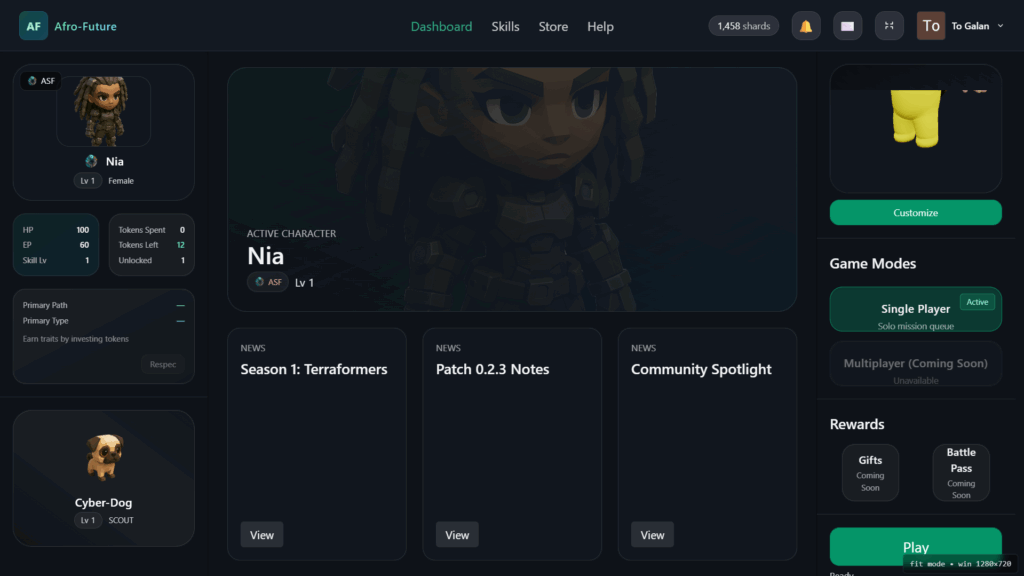
Main Menu – The Front Door to the Game
One of the first things I realized while testing builds is that the game desperately needed a proper entry point. Until now, I’d been jumping straight into maps or debug views, which worked fine for me but didn’t feel like an actual game to anyone else.
So I built out a main menu system that acts as the front door. Right now, it’s pretty clean: it lets you log in, access your profile, jump into single-player missions, and (eventually) multiplayer. I also set up slots for news, patch notes, and community spotlights, since I want Afro-Future Rising to feel like a living game even from the moment you boot it up.
Designing the menu forced me to think ahead about navigation flow. How will players move from menu to customization to missions without feeling lost? How do I surface character info without overwhelming new players? I kept it modular, so I can keep iterating without tearing it all down later.
It’s not flashy yet, but it’s functional, and for the first time, booting up the game feels like stepping into an actual experience instead of a prototype.
Google Login – First Steps Toward Accounts
With the menu in place, I wanted to add some real user infrastructure. Indie devs don’t always think about logins this early, but because I plan for Afro-Future Rising to have community-driven features, persistent progression, and multiplayer, I needed a basic account system.
I started with Google login integration. It’s one of the simpler OAuth flows to hook up, and it’s familiar for most players. Right now, you can log in with your Google account, and the game recognizes your profile. Down the line, this will tie into saved characters, stats, and rewards.
It’s not glamorous work — OAuth tokens, backend verification, making sure I don’t leak data or break sessions — but it’s the kind of plumbing that needs to exist if the game is going to scale. For now, I’m keeping it lightweight, but this sets up the base for when I expand into cloud saves and proper account management.
WebRTC – Early Networking Foundations
Multiplayer is a huge ambition for Afro-Future Rising, and while I know I won’t be shipping a polished online mode anytime soon, I wanted to at least start laying the groundwork. That’s where WebRTC comes in.
I’ve added the base layer for WebRTC connections, which will eventually power peer-to-peer sessions and real-time communication. Right now, it’s just the skeleton: initializing connections, testing signaling, and making sure that I can establish sessions between clients.
There’s still a ton of work to do here — lobbies, matchmaking, syncing game states, handling latency — but the core tech is now hooked up. Even just seeing two clients connect successfully felt like a big milestone. It makes the dream of multiplayer feel a little more real, even if it’s just the base wiring for now.
My goal is to keep multiplayer optional at first. Single-player missions will always be the core, but having a peer-to-peer backbone will open up co-op exploration, faction-based battles, and more emergent gameplay in the future.
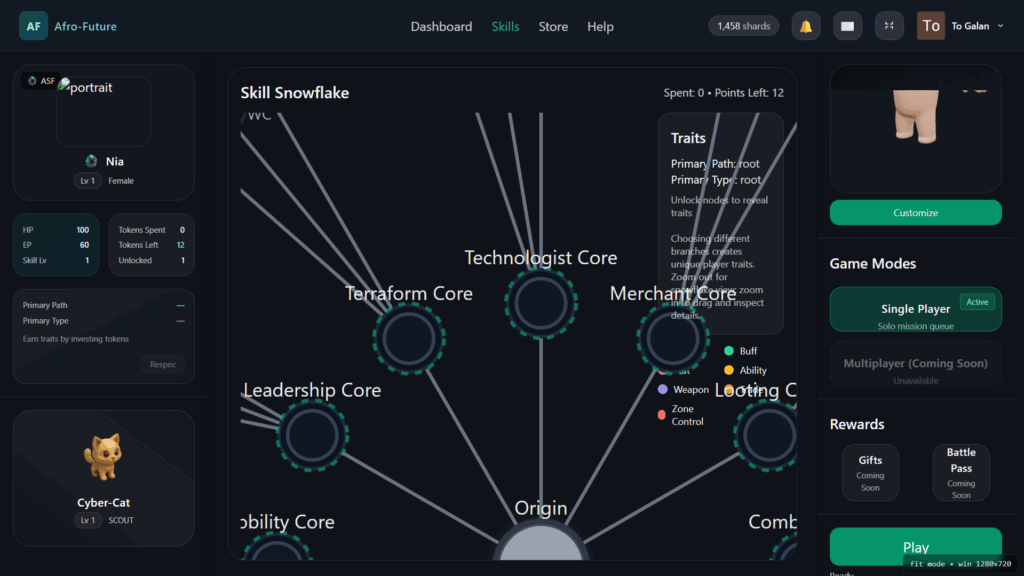
Skill Tree – Building the Snowflake
The biggest system I’ve started building is the skill tree, which I call the “Skill Snowflake.”
From the beginning, I wanted progression in Afro-Future Rising to feel non-linear. Too many games lock players into rigid classes or skill paths. My idea was to let players branch outward in multiple directions, defining their character traits based on the path they choose, without being able to reset or “perfectly optimize.” This way, every player’s build feels unique to their playstyle.
The snowflake structure is starting to take shape. At the center is the Origin, and from there players can branch into major cores like:
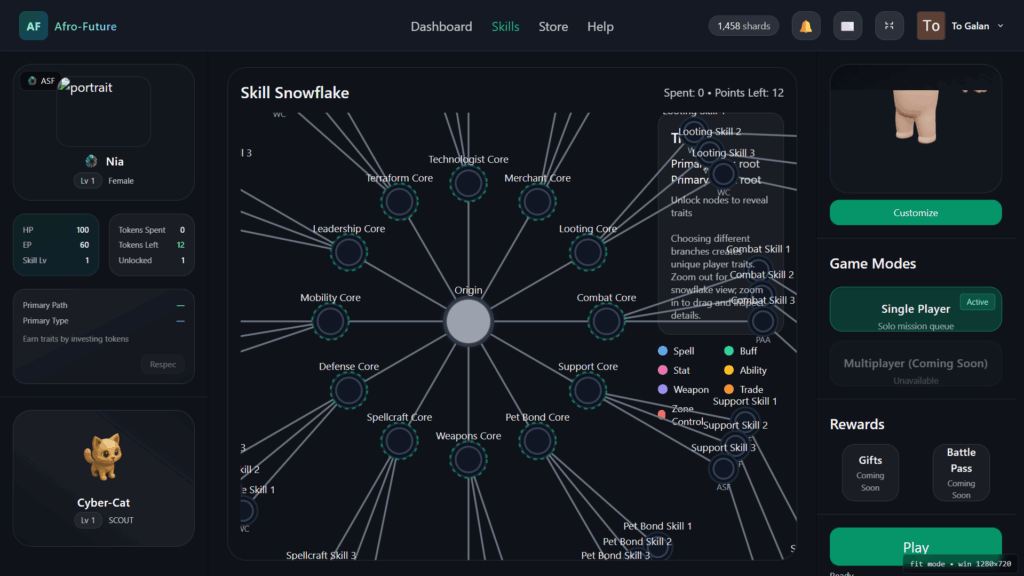
- Technologist – focused on tools, gadgets, and tech-based enhancements.
- Terraform – reshaping the environment, controlling terrain and resources.
- Merchant – trade, economics, and leveraging resources.
- Leadership – rallying allies, influencing zones of control.
- Combat – direct offense and defense.
- Spellcraft – abilities tied to mastery and unique powers.
- Pet Bond – skills tied to your companion animals.
- Mobility / Defense / Support – tactical and survival-based branches.
Each core then branches into traits, which are unlocked by spending tokens. These traits define unique player abilities and stats — things like weapon mastery, spell effects, buffs, or even how your pet interacts with enemies.
Right now, the UI for the snowflake is basic but functional. You can zoom in and out, hover over nodes, and see where each branch leads. The next step will be to wire up token spending and tie the traits back into actual character abilities.